Introduction
Investing in or raising money for a start-up can be an exciting milestone. For founders, it can provide the capital needed to turn a promising idea into a scalable business. For investors, it offers the opportunity to back innovative companies at an early stage and share in their future success.
However, whilst headlines often focus on impressive valuations, funding rounds and successful exits, the reality is that venture capital investments involve a series of legal, commercial and practical steps that are often unfamiliar to first-time founders and investors alike.
In this series, we will demystify the venture capital investment process by exploring the key stages of a typical investment round, explaining the principal documents and commercial terms, and highlighting some of the issues that founders and investors commonly encounter along the way.
Understanding the Venture Capital Landscape
Not every company seeking investment is at the same point in its journey. A business with little more than an idea and a prototype presents a very different opportunity, and risk profile, to a business with an established customer base and recurring revenue.
Understanding the various funding stages helps explain why investment terms, valuations and investor expectations often differ from one round to the next.
Pre-Seed: Backing an Idea
At the pre-seed stage, a founder may have little more than an idea, a business plan or an early prototype. Funding often comes from the founders themselves, friends and family, angel investors or specialist pre-seed funds.
For investors, this is typically the highest-risk stage, but it can also offer the greatest potential upside if the business succeeds.
Seed: Turning Potential into Progress
By the seed stage, the company has usually progressed beyond the initial concept. It may have launched its product, secured its first customers or begun generating revenue.
Many angel investments take place at this stage. Investors are often backing both the founders and the commercial potential of the business, with funding used to grow the team, develop the product and build market traction.
Series A: Scaling for Growth
Series A funding is often sought once a company has established a viable product and demonstrated market demand. The focus shifts from proving the concept to scaling the business.
At this stage, investors are likely to undertake more detailed due diligence and may seek greater governance and reporting rights.
Series B and Beyond: Accelerating Expansion
Later-stage funding rounds are generally focused on accelerating growth, whether through geographic expansion, recruitment, product development or acquisitions.
A Typical VC Investment: From Initial Discussions to Completion
Whilst no two transactions are identical, most early-stage investments follow a broadly similar path.
The complexity of the process will often depend on factors such as the stage of the business, the amount being invested and the number and type of investors participating in the funding round. Angel investors most commonly participate in pre-seed and seed rounds, providing the capital that enables businesses to grow and reach the milestones required to attract further investment in future funding rounds.
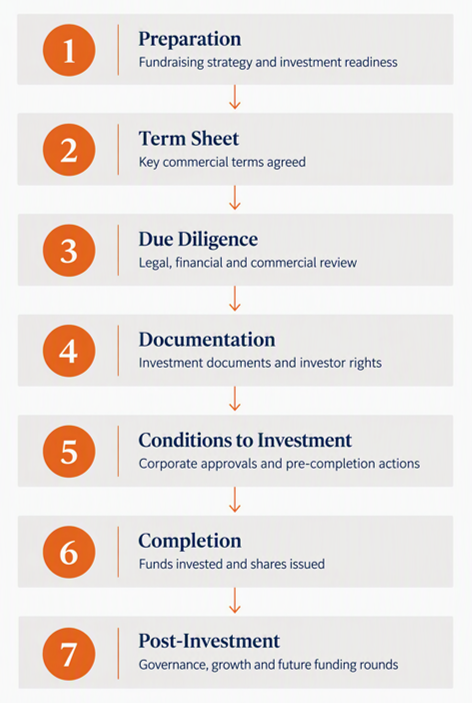
The flowchart below summarises the key stages commonly seen in angel and venture capital investments. Over the coming articles in this series, we will explore each stage in more detail, explaining not only what the relevant documents say, but why they matter and what founders and investors should be thinking about at each step:
This article is for information only and does not constitute legal advice. We recommend seeking professional advice before taking any action on the information provided. If you would like to discuss your specific circumstances, please feel free to contact us on 0118 951 6200.
